Table of Contents
When I started building DNSAudit.io, I just wanted a simple tool to help me spot DNS problems fast. Nothing fancy. Something I could run on a domain and instantly see the issues that attackers would notice before anyone else did.
I built the first version on weekends, mostly out of curiosity. Then things got interesting. The more domains I scanned, the more patterns started to repeat in front of me.
I kept finding the same misconfigurations across companies of every size. Old records pointing to services that no longer exist. TXT records stuffed with random data. Email security completely broken. Nameservers that had not been touched in years.
The funny part is that most of these problems are invisible until something goes wrong. Then they turn into phishing risks, takeover paths, or quiet information leaks that nobody intended to expose.
What surprised me the most is that many of these issues are the same ones I used to see back in 2003 when I started managing Linux servers. Twenty two years later, nothing has really changed. Different tools. Different clouds. Same DNS problems showing up again and again.
Common Patterns That Keep Appearing
After running thousands of scans, a few things kept appearing more than anything else:
- SPF records that cancel each other out or fail silently
- MX setups that accept email but offer zero protection against spoofing
- TXT records hosting oversized or strange data that does not match any real configuration
- Wildcard DNS pointing everything to cloud buckets that no longer exist
- Nameservers still tied to old providers that people stopped using years ago
- Domains with no DNSSEC at all even when they handle sensitive information
- Subdomains pointing to dead infrastructure, leaving easy takeover openings
These issues show up in startups, mid sized companies, and large enterprises. No one is really immune. Most teams simply assume DNS is already taken care of.
Why DNS Drifts Over Time
A lot of people treat DNS like something you set once and forget. If it resolves, it must be fine. The reality is the opposite. DNS drifts over time. Services get migrated. Teams change. Cloud platforms evolve. And somewhere in that process, a forgotten record becomes a security gap waiting for someone to notice it from the wrong side.
Building DNSAudit.io
DNSAudit.io started as a small checklist for my own projects. It grew from there. The tool now checks for dozens of risks, from basic hygiene to more advanced detection like spotting suspicious TXT payloads that malware families hide inside DNS.
Every check is done through remote, non intrusive analysis. I wanted something anyone could use without exposing access to anything sensitive.
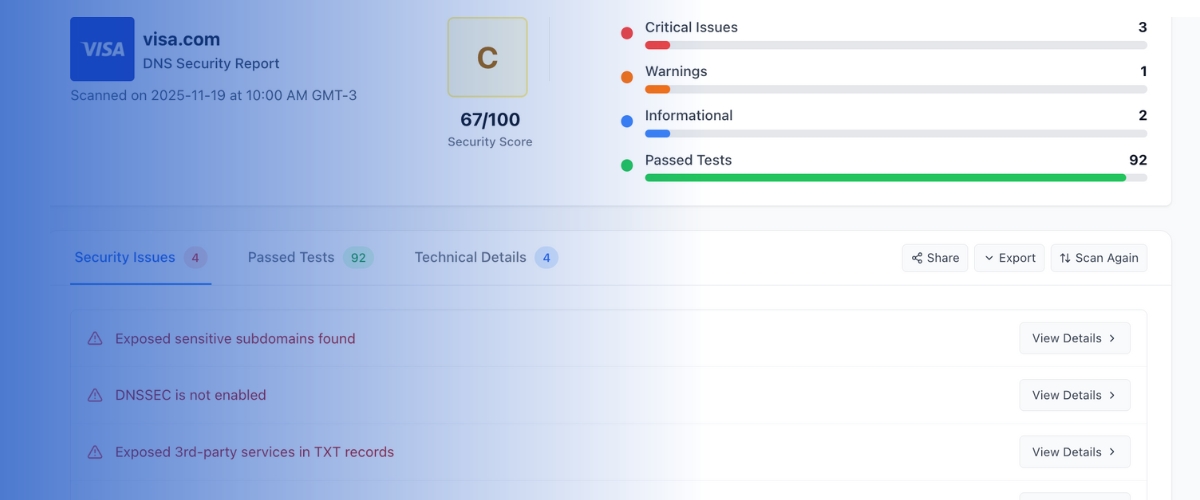
What I like most about this project is how early it surfaces problems. You do not need to be a DNS expert. You run a scan, read the findings, and you know what needs attention. No guesswork. No complicated explanations. Just clear information.
What's Next
This is the first post on the DNSAudit.io blog. I hope it sets the tone for what I want this project to be. Practical. Simple. Clear. Focused on helping people understand their DNS surface and fix the issues that tend to fade into the background.
I will be sharing more research, new detection ideas, case studies, and some of the things I am building next.
Thanks for checking out the project. If you have ideas or want to help shape the next steps, I am always open to suggestions.